
















Back
Back
Back
Back




One of the most important decisions that an asset-intensive enterprise must make is how to manage and care for its assets (i.e. equipment, buildings, plants and machinery). This is a decision that affects everyone in the organization, from the plant operators, to the engineers and all the way to executives in the C-suite. The solution will be different depending on the needs of the business and how each uses its assets.
For the manufacturing industry, in which machines are directly related to the delivery of the end product, the aim must be to implement solutions that ensure and improve the reliability and availability of physical assets essential to the operation of the enterprise as a whole. For over a decade, our team of experts has been partnering with manufacturing companies of all shapes and sizes and across all process and discrete sectors to help them identify and implement the most cost-effective Asset Performance Management (APM) strategies, technologies and solutions for their organization.
In order to increase their Return on Assets (ROA), leading organizations today are implementing digital solutions for Asset Performance Management (APM). This is especially true of companies competing in industries where asset performance has a direct impact on business outputs, such as in the Energy, Utilities, Manufacturing and Transportation sectors. Asset Performance Management solutions enhance Enterprise Asset Management (EAM) by delivering information and insights related to asset condition and performance at the point of action to minimize unplanned repair work, reduce equipment failure, increase asset availability and extend asset life without incurring unnecessary costs.
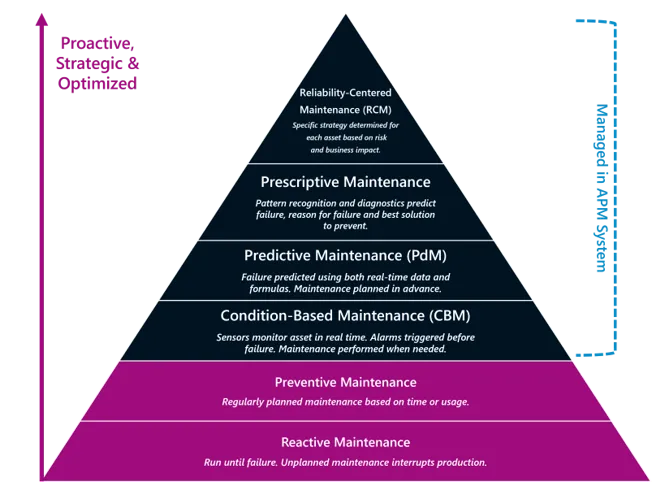
Condition-Based Asset Maintenance (CBM) is a strategy that monitors the real-time functional condition of an asset to decide what maintenance needs to be done. CBM dictates that maintenance should only be performed when certain indicators show signs of decreasing performance or upcoming failure. Checking a machine for these indicators may include non-invasive measurements, visual inspection, performance data and scheduled tests. Most often, conditional data is gathered at certain intervals or continuously using Internet of Things (IoT) sensor devices to measure vital equipment parameters (e.g. temperature, pressure, vibration, noise).
Successful APM solutions monitor the performance of your assets and compare that data against specifications, constraints and rules for asset usage, health and reliability. The goal of CBM is to spot upcoming equipment failure so maintenance can be scheduled when it is needed, and not before, optimizing the amount of time spent on maintenance tasks. Asset conditions trigger notifications and alarms based on configurable workflows to alert maintenance teams in the moment of need, but within a long enough time period before failure, so that maintenance can be executed before the asset fails or performance falls below the optimal level.
Predictive Asset Maintenance (PdM) is one of the most advanced types of proactive maintenance currently available, and one of the most effective in driving a high ROA. With time-based (preventive or preventative) maintenance, organizations run the risk of performing too much maintenance or not enough. And with reactive maintenance, maintenance is performed when needed, but at the cost of unscheduled downtime. Predictive Maintenance solves these issues.
Successful APM solutions enable your different assets and systems to connect, work together, share, analyze and action data in order to perform analytics and enable predictive asset maintenance. Predictive Maintenance relies on precise formulas, in addition to condition-based measurements from sensors, to predict when asset failures will occur. Asset maintenance work is planned and performed based on the analysis of these parameters. Predictive analytics enable manufacturers to correlate factors such as historical and real-time performance data, maintenance records, inspection reports and environmental data to determine when asset degradation or failure might occur. You can then define an optimal maintenance schedule based on these analytics to minimize maintenance costs and maintenance downtime. This helps reduce costly emergency repairs, maximize machine up-time and increase throughput.
Some APM platforms also enable Prescriptive Asset Maintenance, which aims to prevent the conditions that lead to machine faults and failures in the first place. Leveraging Machine Learning, Artificial Intelligence, pattern recognition and diagnostics, Prescriptive Maintenance involves not only detecting degradation in assets well ahead of failure, but also identifying the reason the failure will occur and prescribing a solution to mitigate that problem.
The technique is driven by models and a broad knowledge base within the system that can identify an issue, evaluate why it happened and identify or prescribe the best method for repairing it. Prescriptive Maintenance uses multiple equipment and process data variables for analysis and is best suited for the maintenance of complex assets requiring advanced skills for problem diagnosis, issues that even the most experienced technician would not be able to determine by inspecting the machine or performance data alone.
Reliability-Centered Asset Maintenance (RCM) is a corporate-level asset management strategy that is implemented to optimize the maintenance program of an entire enterprise. The result of an RCM program is the implementation of a specific maintenance strategy for each of the assets within a facility or company. Reliability-Centered Maintenance was originally a product of airline maintenance schedules, which are among the most intensive of any industry. Airlines must undergo extensive servicing for safety, but these services must be balanced with the need for the airline to generate revenue and continue operating. Balancing these two elements is difficult as machinery (i.e. airplanes) is becoming increasingly complex and has multiple possible failure modes. While Reliability-Centered Maintenance requires more time up front, it helps organizations establish a maintenance plan that is both cost and equipment-effective in the long run.
The first step in RCM is to evaluate each asset’s purpose, failure modes and business impact. Evaluation criteria for RCM processes is defined in the technical standard SAE JA1011. The process begins with these seven questions:
Answering these questions will give the business an idea of which components of RCM to implement for a particular asset: Reactive, Preventive, Condition-Based, Predictive or Prescriptive Maintenance. One or more of these maintenance types can be implemented across an organization's assets.
The strategy which an organization employs to manage the performance and maintenance of critical infrastructure and assets plays a major role in the productivity and profitability of the business as a whole. In manufacturing, studies show that unplanned downtime can cost an enterprise 10 times more than planned maintenance due to the disruption to business and lost production. IndX delivers proven technology solutions for Asset Performance Management, Asset Monitoring and Asset Maintenance to manufacturing customers across all industrial sectors. By integrating process visibility, data intelligence, pattern recognition and predictive analytics into their asset management portfolios, asset-centric organizations can ensure the performance of their critical assets while reducing operational costs and risks at the same time.