

















Results at a Glance

Customer + Project Snapshot
- Customer: An international Pharmaceutical manufacturer
- Industry: Pharmaceutical
- Locations: 3 major global manufacturing and distribution nodes
- Technology: SAP ERP, Stöcklin Intralogistics and IndX custom scanning solution
- Project: Digital manufacturing transformation
- Timeline: 4 months
The customer is an international pharmaceutical company operating in the life sciences, manufacturing and distributing serialized healthcare products globally. The customer runs highly automated warehouse operations integrating automated storage and retrieval systems with SAP and associated regulatory compliance systems (Track and Trace). They are actively modernizing their supply chain execution by implementing automated pallet tracking solutions.
The Challenge
Even within a highly automated warehouse environment, the transition between automated material movement and outbound dispatch can leave critical process steps dependent on manual interaction. For this customer, that transition created a gap between warehouse throughput, operational visibility and pharmaceutical compliance.
Like many pharmaceutical companies, the customer had points of friction between warehouse throughput, operational visibility and strict pharmaceutical compliance, when dispatching orders and loading trucks from their warehouse.
The existing outbound dispatch process relied on manual verification and disconnected systems to move staged pallets from an automated intralogistics movement system to the loading dock. This created an operational bottleneck that limited warehouse throughput, increased the risk of human scanning error and delayed critical regulatory compliance logging for serialized pharmaceutical goods. This included:
1. Manual Bottlenecks at High-Speed Dispatch
While the intralogistics storage and conveyor systems are automated, the physical verification and track-and-trace logging at extraction had relied on manual operator interaction, creating an artificial drag on dispatch speed.
2. Compliance and Verification Risks
In a serialized pharmaceutical supply chain, missing a single pallet scan or incorrectly matching a scan to an outbound delivery causes non-compliance and halts truck loading.
3. Lack of Real-Time Extraction Visibility
When physical pallets are retrieved from the staging area, operators lack a single-pane-of-glass dashboard to confirm that all expected pallets have safely arrived at the gate, making stuck or missing pallets difficult to detect until after the loading sequence has stalled.

The Solution
The customer had previously made major investments in SAP enterprise software and automated intralogistics (warehouse robotics), but a manual gap remained right at the transition point between the automated buffer and the loading gate. A surgical solution was required to bridge the platforms of automation“.
The existing IndX handheld scanning and goods movement solution was extended to incorporate fixed industrial barcode scanners, creating an integration layer that connects physical conveyor reads directly with ERP transaction records. This removed the need for manual scanning during final loading and goods issue. Rather than introducing another complex, out-of-the-box platform, IndX adapted the existing solution around a focused set of SAP transactions and online processes. This provided the customer with a simpler, more cost-effective approach while building on technology already in place.
IndX worked with the customer to define a simplified architecture across the core components, extending the existing scanning solution while reducing system complexity and aligning the approach with SAP Clean Core principles.
The scope included the following:
- Web-based form displayed on a device at the extraction point that enables the operator to initiate pallet retrieval and monitor scan progress.
- Integration with SAP providing the business logic and data access for the device user interface and scanner middleware.
- Assist in identifying appropriate fixed scanner hardware selection, mounting and procurement.
- Warehouse network analysis.
- Testing and deployment.
How It Worked
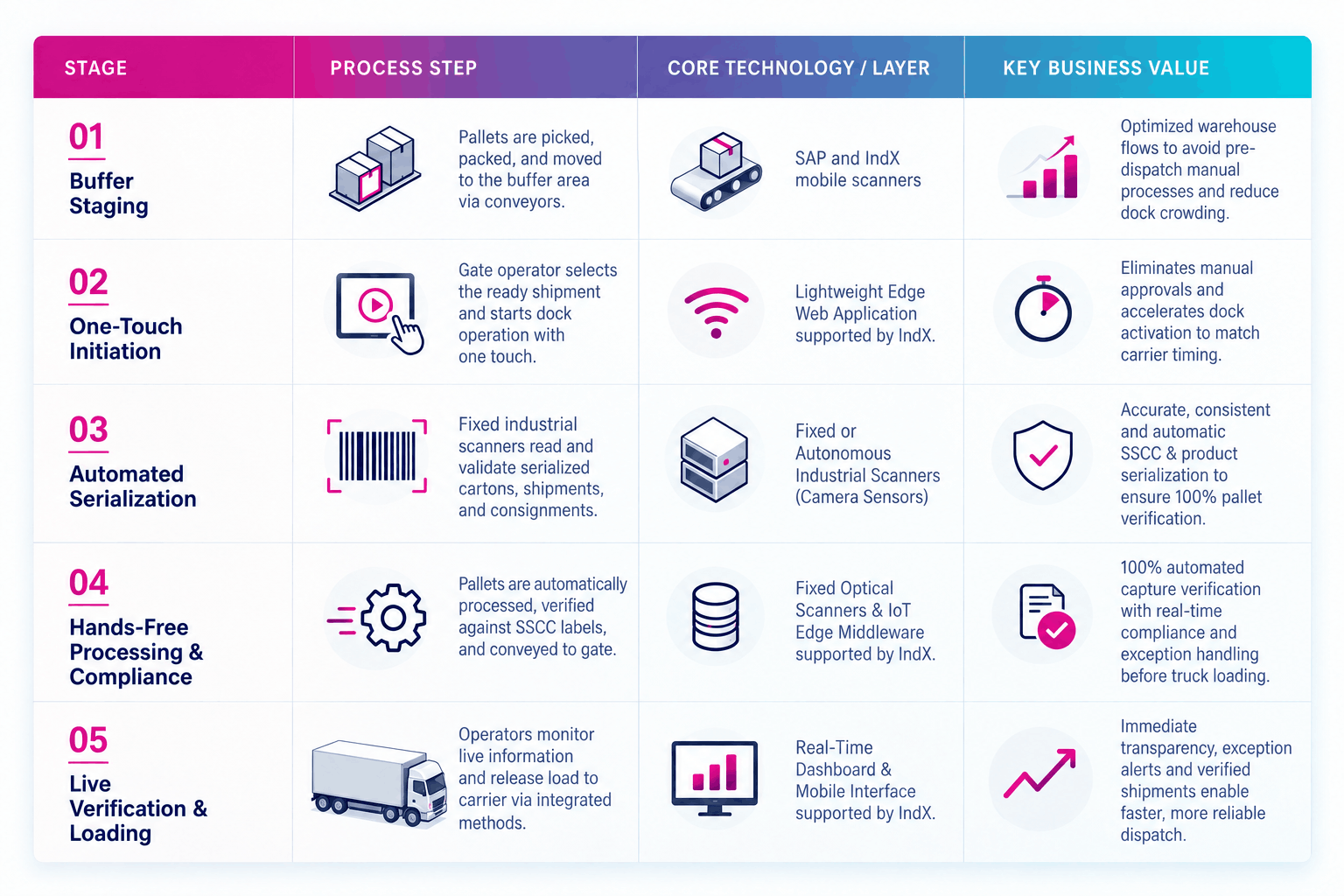
The existing IndX handheld solution for goods movement and scanning was extended to incorporate fixed scanners and integrate with the robotic intralogistics solution. This eliminated manual, error-prone processes that had created bottlenecks and delays in outbound operations, particularly during loading and dispatch. A live dashboard also provides operators and dispatchers with real-time visibility into the process.
The Results
By connecting physical pallet movement, automated scanning and SAP transactions, the solution addressed the manual transition point that had affected outbound dispatch. The resulting process provides automated scanning, real-time compliance logging and live verification as pallets move from buffer storage through loading.
1. Elimination of Manual Scanning & Human Error
Replacing handheld RF guns with fixed scanners eliminates missed scans, barcode misreads and operator scanning fatigue. It guarantees that every single SSCC label is accurately captured as the pallet glides past on the conveyor at line speed.
2. Automated Pharma Compliance & Real-Time Track and Trace Logging
For serialized pharmaceutical stock, the system automatically performs Handling Unit lookups and registers the regulatory serialization event directly in SAP ATTP in real time. This ensures 100% data integrity and regulatory compliance without introducing manual verification bottlenecks at the dock door.
3. Increased Dispatch Velocity & Immediate Discrepancy Resolution
Decoupling physical pallet movement from manual administrative steps dramatically speeds up throughput from buffer storage to staging. If a pallet is held up or missing, the tablet UI's live dashboard instantly identifies the exact missing item before loading begins, preventing delayed truck departures.

Why It Matters & What's Next
The main implications of this solution can be framed around three key strategic pillars:
1. An Efficient "Bridge-Builder" for Intralogistics Automation
It eliminates the operational disconnect between physical material handling robotics and ERP business transactions without requiring costly custom modifications to either system.
2. Clean Core & AI-Ready Architecture
By keeping business logic, data and serialization records cleanly structured within standard SAP entities and API endpoints, the system establishes high-integrity data lineage. This centralized data model feeds directly into the SAP enterprise semantic layer and Knowledge Graph, making warehouse events instantly accessible for future predictive analytics, automated exception handling and agentic AI workflows.
3. High Scalability & Rapid Plant Rollout
The solution is decoupled, modular and standardized, so rolling out the solution to other manufacturing sites or distribution centers requires minimal software changes drastically reducing future deployment costs and time-to-value across the enterprise network.
Facing Similar Warehouse Logistics Challenges?
Talk with an IndX expert about your current environment and identify where integration, process or technology gaps may be limiting your operations.