











What this Solution Fixes

logo
Requirements, system models and product data often live in separate engineering environments.
logo
IndX connects MBSE with PLM and the wider digital thread so requirements, architecture and product definition stay synchronized.
logo
Mechanical, electrical, software and simulation teams make decisions without shared system context.
logo
A connected system architecture gives every engineering discipline traceable requirements, interfaces and parameters within the same product context.
logo
Verification happens too late, when system-level problems are expensive to correct.
logo
IndX connects requirements directly to simulation, analysis and test activities to enable continuous verification throughout development.
logo
Engineering changes create uncertainty across requirements, interfaces, models and product configurations.
logo
Connected system baselines expose change impact across engineering disciplines while preserving configuration and product intent.

Most MBSE programs stop at the model. That is the problem.

Requirements get captured, architectures get built and simulations get run - but the thread often breaks when engineering moves into detailed design, PLM, software, verification and downstream execution.

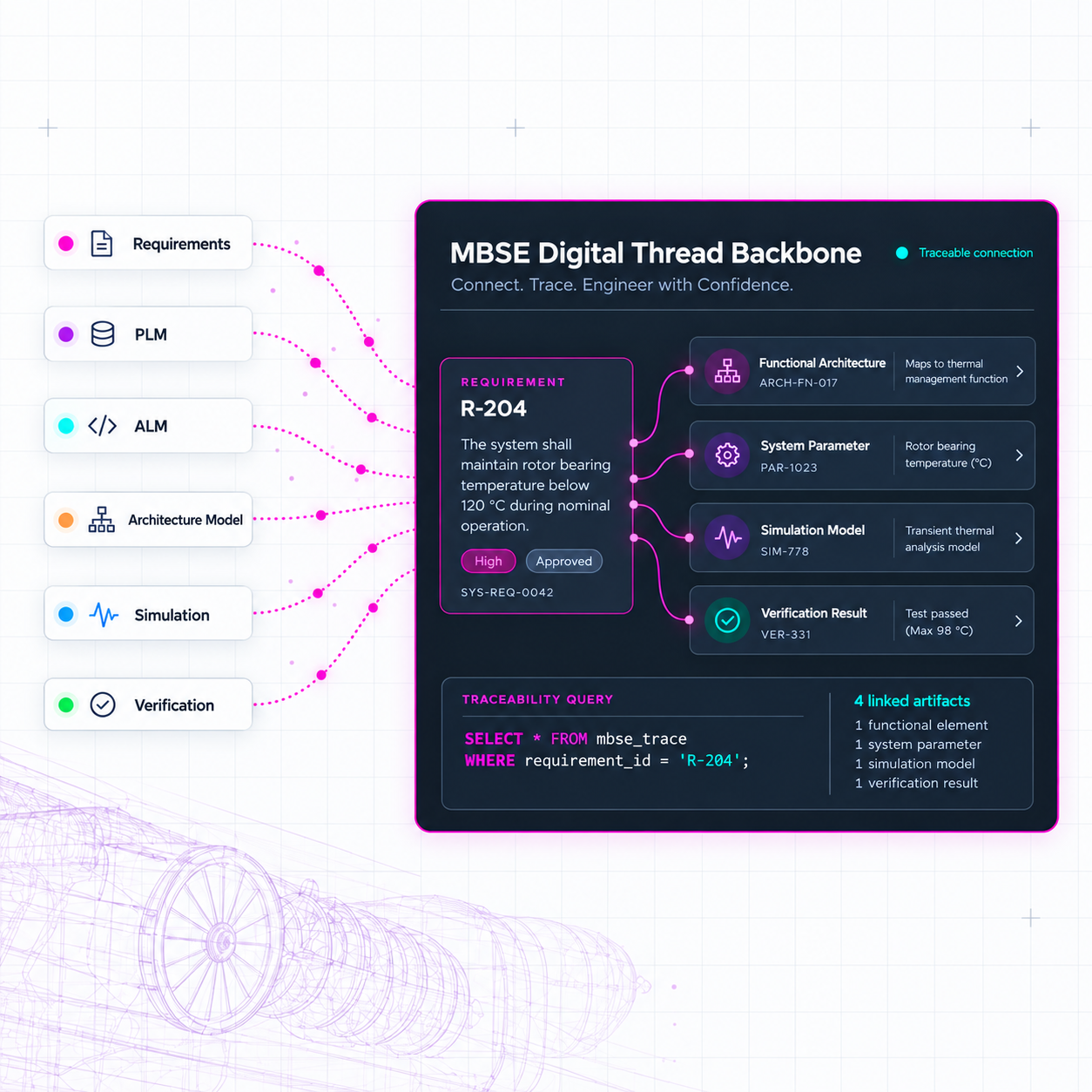
IndX takes MBSE further. We connect requirements, system architecture, parameters, simulation, PLM, ALM and verification into the broader digital thread, so the system definition does not disappear once real engineering work begins.

IndX has implemented MBSE and extended it into the digital thread for complex engineering organizations, including leading space startups and global automotive enterprises.

Model-Based Systems Engineering

MBSE provides a structured way to define what a system must do, how its functions and components interact, and how teams verify that requirements have been satisfied.

Requirements connect to functional architecture, interfaces and parameters. Engineering and simulation models provide evidence of system behavior, while verification activities link results back to the original requirements.

Requirements → Architecture → Parameters → Engineering Models → Simulation → Verification

This gives teams a shared system definition and makes dependencies, change impact and verification status easier to understand. The IndX MBSE material similarly connects requirements, parameters, architecture and verification through a PLM-backed digital thread.

MBSE Across the Digital Thread

IndX extends MBSE beyond conceptual engineering by connecting it to the wider lifecycle.

Systems information can remain linked through detailed design, simulation, verification, manufacturing preparation and downstream processes, supporting continuity across:

Mission / Customer Need → Requirements → Architecture → Design → Analysis → Verification → Manufacturing → Operation

For complex programs, this creates a more consistent system baseline across engineering change, configuration and verification.

SCOPE OF MODEL-BASED SYSTEMS ENGINEERING (MBSE)

  • Requirements management
  • Functional modeling
  • System architecture
  • Parameter management
  • Interface management
  • Multi-domain engineering
  • System simulation
  • Design-space exploration
  • Verification and validation
  • Change-impact analysis
  • Configuration management
  • Model lifecycle management
  • PLM integration
  • ALM integration
  • Digital thread integration

FEATURES OF MODEL-BASED SYSTEMS ENGINEERING (MBSE)

  • Requirements traceability
  • Functional architecture modeling
  • Parameter allocation
  • Interface traceability
  • Cross-domain engineering
  • Multi-domain simulation
  • Continuous verification
  • Change-impact visibility
  • System baseline management
  • Reusable system models
  • Digital thread connectivity

BENEFITS OF MODEL-BASED SYSTEMS ENGINEERING (MBSE)

  • Earlier integration issue detection
  • Reduced engineering rework
  • Improved requirement traceability
  • Faster verification
  • Better change visibility
  • Stronger configuration control
  • Improved cross-domain collaboration
  • Increased design reuse
  • Reduced program risk
  • Greater lifecycle continuity

INDX’S EXPERTISE

IndX brings together systems engineering, PLM, ALM, product design, simulation and manufacturing expertise to make MBSE part of the broader engineering digital thread.

Our teams help customers define system architectures, connect requirements and parameters, integrate engineering models, establish verification workflows and manage system information within the product lifecycle backbone.

This matters because MBSE creates the most value when it is connected to the environments where engineering decisions are actually executed.

IndX has applied this approach across complex aerospace, space, automotive, industrial machinery, energy and other highly engineered products, including programs where systems engineering forms part of a larger digital-thread transformation.
No items found.

Our Approach

1
Define the System Architecture
Establish requirements, functions, architecture, interfaces and parameters around a consistent system definition.
2
Connect Engineering Domains
Integrate system models with mechanical, electrical, software and simulation environments while maintaining cross-domain traceability.
3
Verify Through the Digital Thread
Connect simulation, analysis and test evidence back to requirements while maintaining configuration and change throughout development.
image
Aerospace & Defense
image
4
min
Axiom Space & IndX: Transforming Space Missions
watch now
image
No items found.