













Back
Back


For custom, high-value, Engineer-to-order (ETO) machinery, waiting for field failures to train maintenance models is too late. IndX combines product simulation, executable digital twins, virtual sensor data, and AI to help service and reliability teams anticipate failures earlier, before downtime, warranty exposure, and emergency service costs compound.
Most predictive maintenance programs start only after the asset has enough operating history. That works for repeatable production lines and large installed fleets. It breaks down when the machine is customized, expensive, rarely fails, and each failure creates major operational or contractual exposure.
For engineer-to-order machinery, your team may already have deep product knowledge, strong simulation models, and years of engineering expertise. The problem is that this intelligence often stays trapped in design and validation, disconnected from service, reliability, and field operations. AI can close that gap, but only if it has something to learn from before the first breakdown.
AI models cannot wait years for enough useful incidents to accumulate before they deliver value.
One failure can disrupt production, damage customer trust, and consume the entire service margin.
Repeated failure signatures are harder for a model to detect when every asset is engineered differently.
Engineering teams know the product. Service teams need AI to turn that into actionable prediction.
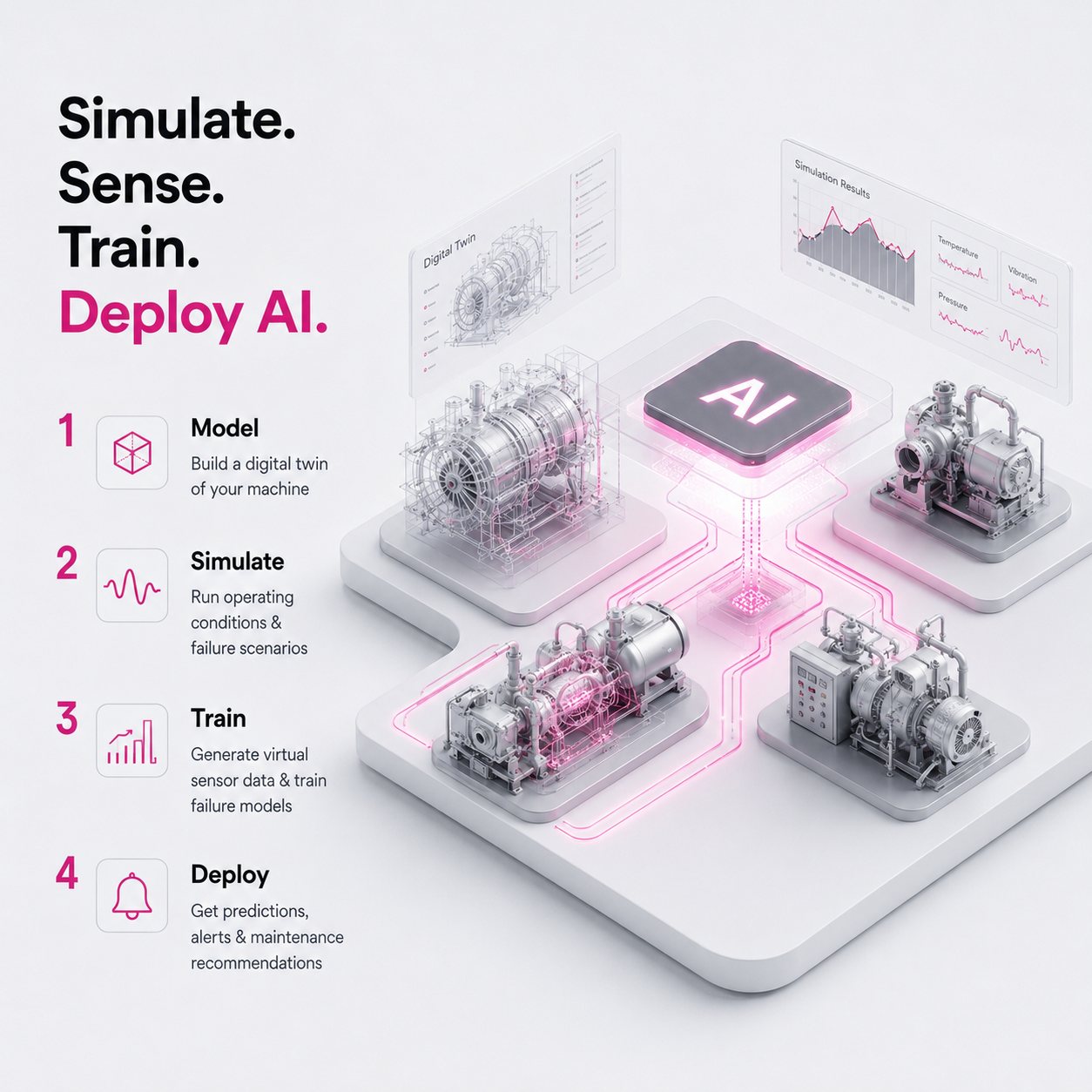
A repeatable path from engineering simulation to a trained AI model in the field, without waiting for years of failure data to arrive.
Use existing engineering and simulation data to create a high-fidelity digital model of the machine or subsystem.
Simulate normal, degraded, and edge-case conditions to create training signals before field data exists.
Apply AI and machine learning to identify leading indicators, failure signatures, and remaining-useful-life signals.
Powered by IndX AI LabsOperationalize the model through Simcenter, Insights Hub, Mendix, RapidMiner, and integrations to CMMS or service systems.
Simulation-led maintenance AI is measured the way your operation is measured: in avoided downtime, protected margin, and service revenue.
Reduce the probability or severity of high-cost field failures on your most critical assets.
Fewer reactive dispatches, fewer rush parts, and better remote diagnosis before a truck rolls.
Let AI identify risk earlier and prevent preventable claims before they hit the balance sheet.
Turn AI-driven insight into premium digital service packages your customers will pay for.
Validate operating behavior earlier for new machines, reducing risk at handover.
Create a repeatable model foundation that scales across entire machine families.
See whether simulation-led maintenance AI fits your highest-value asset family.
These are the assets where simulation-led AI has the clearest payback, because failures are expensive and field data arrives too slowly.

A clear data thread that starts in engineering, runs through a trained AI failure model, and closes the loop with real operating data as it arrives.
Simulation-led predictive maintenance is developed by IndX AI Labs, where applied AI meets real industrial execution. The Labs turn simulation, machine learning, and intelligent agents into production-grade AI that delivers measurable ROI, not shiny pilots that never leave the lab.
That means the maintenance AI you deploy is validated against physics, engineering models, and real service economics before it ever touches a live asset.

A 90-minute Simulation-Led Maintenance Readiness Assessment with an IndX AI and Digital Twin specialist.
No. It is usually an accelerator for high-value assets where traditional PdM does not yet have enough data. The AI can feed or enhance existing reliability, CMMS, IoT, and service workflows.
No. The value of simulation-led maintenance AI is that it can begin with engineering models, physics, simulation, and limited operating data, then improve as real field data arrives.
Start with assets where one failure has material downtime, warranty, safety, or customer-service impact. The best pilot candidate is usually a high-value subsystem with known failure modes and available simulation or engineering models.
A practical validation pilot can often be structured in roughly 12 weeks, depending on model readiness, data availability, and integration scope.
Full programs for high-value assets may range from $500k to $1M and up depending on scope, model complexity, integrations, and deployment requirements. The assessment defines a narrower AI pilot and business case first.
In 90 minutes, IndX can help you identify whether simulation-led maintenance AI is viable for your highest-value asset family, what it would take to pilot, and where the ROI is likely to come from.


