

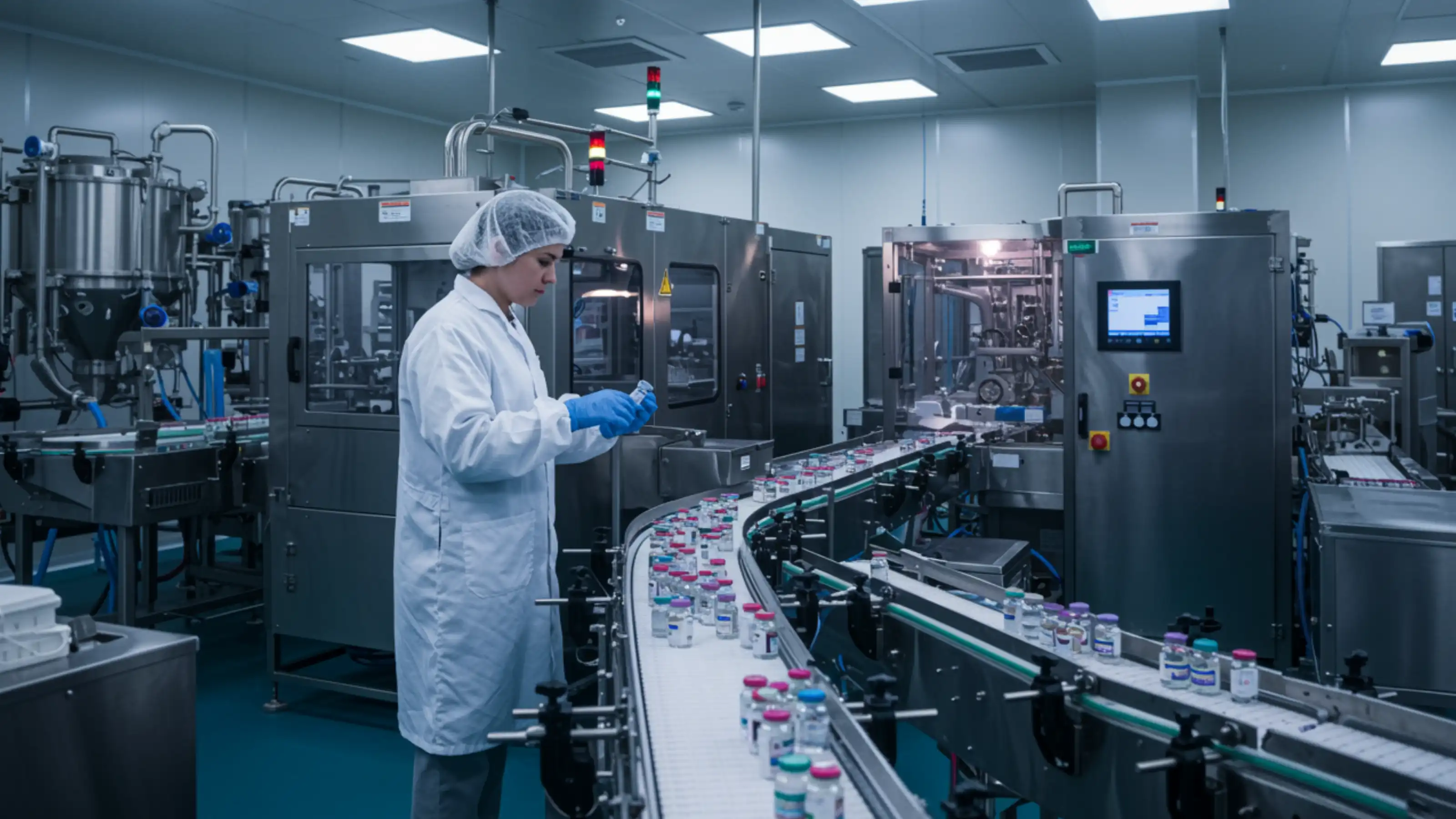









Industrial AI + Operational Data

The answer is in your database. Your engineers just can't get to it.

IndX Industrial Data Copilot lets manufacturing, engineering and operations teams ask questions in plain English across legacy SQL, SAP extracts, Oracle, MES and operational databases, and get governed answers without waiting on a SQL expert.

No SQLrequired for end users
Existing datano rip-and-replace
Read-only firstgoverned by design
From $50Kfocused deployments
Industrial Data Copilot: SAP, Oracle, SQL, MES and Historian sources feeding a governed copilot chat that answers an operational question with generated SQL and query traceability.
The operational data bottleneck

Your data isn't missing. It is operationally inaccessible.

Plants hold years of maintenance, quality, production and engineering history. The problem is that the people who need answers have to know the table, the transaction, the report, the system owner, or the one person who can write the query.

01

Every ad hoc question becomes a ticket

Operations asks. An analyst translates. IT locates the source. Someone writes SQL. By the time the answer arrives, the decision window has already moved.

02

Dashboards only answer questions you predicted

BI is excellent for recurring KPIs. It is weaker when an engineer asks a one-off question during a failure investigation, an audit, a deviation or an improvement event.

03

Legacy data outlives the interface around it

Old SAP extracts, Oracle databases, retired applications and SQL archives still hold valuable history. The tooling and tribal knowledge needed to use it keeps disappearing.

04

Data access is a people-dependency problem

The bottleneck is often not the database. It is dependence on a small group of SAP, SQL or reporting experts to interpret schemas and retrieve the right records.

From ticket queue to conversation

Ask the question the way your team actually thinks.

The copilot interprets the question, maps it to approved industrial data, generates a governed query, returns the result and preserves traceability.

Which compressor failures in the last 24 months occurred before 5,000 operating hours, and what maintenance actions followed?

5 matching events found

Most common modeBearing vibration
Median operating hours4,420 h
Typical actionInspect and replace bearing
SELECT failure_mode, operating_hours, action FROM asset_events JOIN work_orders...
3 tablesread-onlyquery trace saved
Best-fit industrial questions

Industrial questions are messy. That is the point.

This is not a generic "chat with any data" product. We focus the copilot on a defined operational domain: its vocabulary, its relationships and its trusted source tables.

Maintenance and reliability history

Retrieve prior failures, work orders, runtime and maintenance actions without manually joining multiple tables.

"Show failures before 5,000 hours and the work orders that followed."

Quality and nonconformance

Search deviation, inspection, NCR and disposition records to accelerate fact-finding during investigations.

"Which nonconformances mention the same supplier lot and defect family?"

Production and process analysis

Ask ad hoc questions across production history, downtime, orders, lots, shifts and process outcomes.

"Which shifts produced the highest scrap on this SKU after the changeover?"

Engineering and service

Connect service history with configuration, product usage, failures or engineering data for deeper troubleshooting.

"Which configurations show the same fault after this component revision?"

Legacy system intelligence

Preserve access to data in retired or hard-to-use systems without forcing every user back into the original interface.

"Find all historical service orders for this serial family in the archived SAP copy."

Analyst self-service

Give operations analysts a conversational layer for exploratory retrieval before they build a report or escalate to IT.

"Break this downtime category by line, product family and shift for the last 90 days."
The IndX approach

The model is not the product. Trusted context is.

Natural-language-to-SQL only becomes useful when the AI understands your schema, your business language, your access rules and the difference between a technically valid query and an operationally correct answer.

01 · Connect

Approved data sources

Legacy SQL, Oracle, SAP extracts, MES databases, quality systems and other operational stores.

02 · Contextualize

Industrial semantic layer

Map table relationships, field meanings, aliases, business rules, asset hierarchies and trusted query examples.

03 · Ask

Natural-language query

Users ask in the vocabulary of maintenance, manufacturing, quality or engineering.

04 · Verify

Governed SQL and answer

Generate approved queries, constrain scope, show source logic and preserve query traceability.

05 · Improve

Feedback and expansion

Refine trusted questions, add domains and expand only after the first domain is trusted.
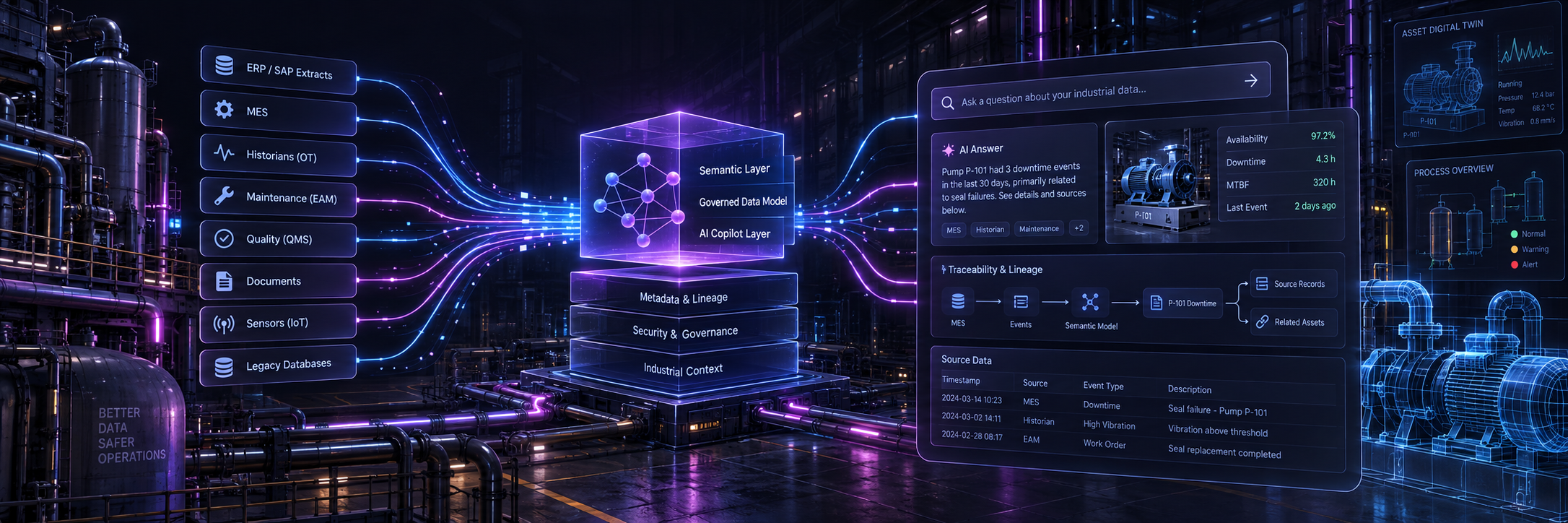
Read-only by defaultStart with governed retrieval, not autonomous write-back.
Role-aware accessRespect the permissions and datasets each user is allowed to see.
Traceable queriesPreserve generated SQL and source context for review.
Model-flexibleDeploy against your approved enterprise AI and security stack.
The business case

Measure the ROI in hours returned to the plant.

The core economic case is simple: fewer analyst queues, less SQL and SAP dependency, faster investigations, lower friction accessing historical data, and where appropriate, the ability to retire expensive legacy reporting tools.

Annual value = user time recovered + analyst and IT hours avoided + faster investigation value + retired tool costs, minus implementation cost.
1h

One hour per week adds up quickly

Across 50 engineers, one hour saved each week returns roughly 2,400 to 2,600 working hours per year, depending on the operating calendar. Illustrative, not a performance guarantee.

IT

Reduce low-value query work

Shift data teams away from repetitive retrieval toward governance, data quality, models and higher-value analysis.

Δt

Compress investigation time

During a downtime, quality or service event, getting the facts hours earlier can matter more than the labor savings alone.

Illustrative ROI calculator

Change the assumptions. The final business case is validated during assessment.
Annual hours returned
Annual labor value
Payback on $50K
Illustrative labor-only model. It excludes the potentially larger value of faster downtime, quality, audit or service investigations.
Built by IndX AI Labs

Applied AI that understands industrial execution.

IndX AI Labs builds AI inside the systems manufacturers already run: MES, SAP, industrial data platforms, digital twins and operational databases. The goal is not another isolated chatbot. It is faster, governed decision-making inside real workflows.

Industrial context firstWe model the language, entities and relationships behind the operational question.
Production-minded architectureSecurity, governance, traceability and system constraints are designed in from the start.
AI inside the digital threadConnect the copilot to manufacturing, maintenance, quality and engineering information flows.
Start narrow, scale with evidenceProve value on one data domain before expanding to more sources or agentic workflows.
Where this wins

Not every company needs another data platform. Some need access to the data they already have.

Strong fit

Large operational SQL or Oracle databases with poor end-user accessibility
SAP or other enterprise data copied into reporting or historical stores
Retired applications where the data stays valuable after the UI or license is gone
Engineering, reliability or quality teams with frequent ad hoc investigations
Organizations where a small group of SQL or SAP experts has become a bottleneck

Probably not the first use case

You already have a governed natural-language analytics layer covering the exact domain
The data is poorly structured, untrusted and lacks basic keys or relationships
The requirement is primarily a fixed KPI dashboard rather than exploratory retrieval
The immediate goal is autonomous write-back into production systems without a governance phase
Implementation pricing
$50K starting from

Start with one high-value data domain and a defined user group. Scope expands only after the accuracy, adoption and business case are demonstrated.

A focused deployment typically covers
  • Use-case and ROI definition
  • First database or schema connection
  • Industrial semantic context and trusted question set
  • Conversational query experience
  • Read-only guardrails and query traceability
  • User validation and expansion roadmap
Final scope, timeline and architecture depend on data complexity, security requirements and the number of connected domains.
FAQ

Common questions.

Start with retrieval and trust. Add complexity only when the business case requires it.

Is this a replacement for BI or dashboards?+
Usually no. Dashboards remain ideal for recurring KPIs and standardized reporting. The copilot is strongest for ad hoc investigative questions that were not anticipated when the dashboard was built.
Does the AI write back to SAP, MES or production databases?+
We recommend starting read-only. That makes it easier to validate accuracy, permissions and business value before considering any action-taking or workflow automation.
How do you reduce incorrect SQL or hallucinated answers?+
The solution is constrained by approved schemas, table relationships, business definitions, trusted examples and access rules. Generated SQL can be retained for traceability and validated against known questions before rollout. We do not claim 100 percent accuracy, which is why governance and traceability come first.
Do we need to migrate our data to a new platform?+
Not necessarily. The value is often strongest when the organization has useful data in existing SQL, Oracle or SAP-derived stores and does not want a major migration just to make that data easier to query.
What is a good first domain?+
Choose a domain with clear structure, frequent ad hoc questions, a known user group and measurable time loss today. Maintenance history, quality investigations and operational reporting archives are often strong starting points.
What does it cost?+
Focused implementations start from $50K. The final investment depends on the number of sources, schema complexity, security architecture, user experience and validation requirements.
Developed from a real aerospace use case

Your engineers already know the questions. Give them a faster way to get the facts.

Built from a real aerospace proof-of-concept, where engineers needed maintenance history, prior failures, operating hours and nonconformance data out of a large SQL copy of SAP, without a technical specialist every time. A 90-minute assessment identifies your best first database, the high-value question set, the governance model and the ROI hypothesis.

Eng IndX | Industries eXcellence™ © 2026